
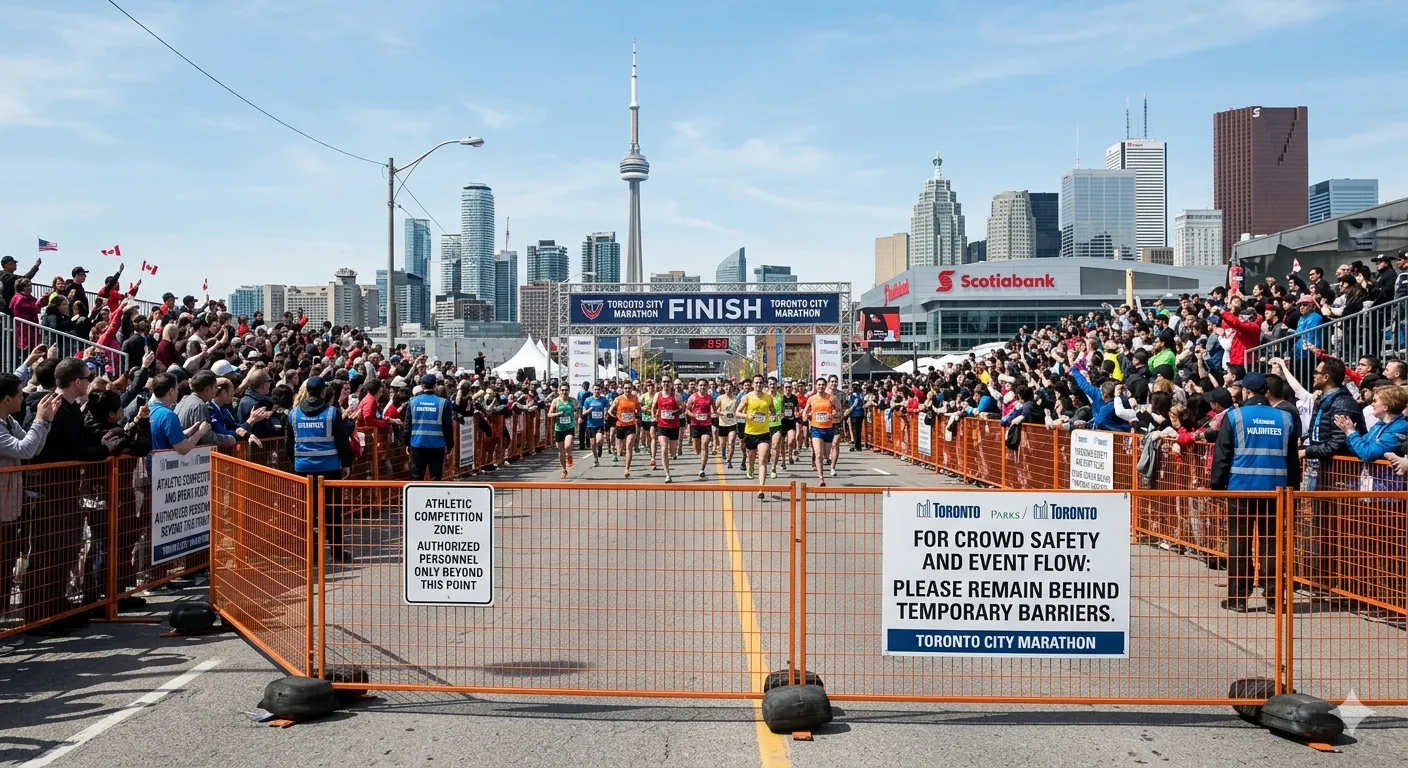
There’s a particular kind of organized chaos that happens at the finish line of a 10K race. Runners are pushing hard for a strong finish. Spectators are clustered 2-3 deep to cheer on their people. Volunteers are managing timing chips, water, and medals. Officials are trying to keep the course clear. And all of this is happening simultaneously in a relatively small space.
Sports event barriers make that organized chaos actually work. They separate athletes from spectators. They define the course. They protect timing equipment and officials. They give spectators a clear sightline without putting them at risk from passing runners, cyclists, or vehicles.
This guide covers crowd control barriers for sports events: races, marathons, triathlons, cycling events, and sporting competitions across Ontario and Quebec.
Why Sports Events Have Unique Barrier Requirements
Sports events are different from concerts and festivals in one important way: the people inside the barriers are moving, often at speed, and often in proximity to the people outside them.
At a concert, barriers define zones and manage pressure. At a race, barriers define a course that’s actively in use for hours. The barrier needs to be reliable for the entire duration, visible to participants, and stable enough to withstand the wind and pressure from high-speed passing rather than crowd push.
The other difference is geometry. Concerts have a stage. Festivals have a field. A marathon course is 42 kilometers of road with hundreds of barrier sections, spectator zones, water stations, medical checkpoints, and a finish line. Barrier planning for a race is a logistical challenge at a completely different scale from a static event venue.
Race Crowd Control: Start Line Setup
The start line is the most complex barrier zone in any race.
You’re managing thousands of participants in corrals organized by pace group, media and official access, start-line sponsor visibility, timing equipment, and spectator viewing, all converging at one physical location simultaneously.
Effective start line barriers create:
- Defined corral sections with clear wave numbering
- Separate entry and exit points for each corral (prevents mixing)
- A protected starting chute that extends 50-100 meters from the starting mat
- Spectator viewing areas are positioned outside the starting chute, but adjacent to it
- Media and sponsor zones with controlled access
- Official access points for timing officials, medical staff, and race directors
The starting chute barriers take the most lateral pressure from excited participants, especially in the corrals nearest the start. Use heavy-base barriers here and ensure all sections are interconnected to prevent gaps from opening under crowd pressure.
Finish Line Barrier Configuration
The finish line is where the event’s emotional peak happens, which means it’s also where crowd management is most challenging.
Finish line barriers need to do several things simultaneously: channel finishers through timing equipment accurately, separate finishers from spectators who want to greet them immediately, maintain a clear medical area for runners who need attention, and hold back a crowd of spectators who are emotionally invested and physically pressing toward the course.
Standard finish line barrier configuration includes:
Finisher chute: A 6-10 meter wide chute extending 30-50 meters from the finish mat. This chute slows runners safely after crossing, allows medical checks, and feeds into medal and recovery areas. Barriers on both sides of the chute should be solid enough that spectators cannot reach over or through them effectively.
Spectator viewing zones: Barriers defining spectator positions on both sides of the course in the final 200-400 meters. These need to be positioned to give sightlines while keeping spectators well clear of the course.
Recovery area: A separate secured area immediately adjacent to the finisher chute for medical assessment, hydration, and participant reunions. Clear access from the finisher chute and controlled external access prevent congestion.
Course Barrier Design for Marathons and Races
Full-course barrier deployment for a major race is a significant logistical undertaking. Here’s how course barriers are typically organized:
Continuous Course Sections
In dense urban areas with high spectator volumes (like the final kilometers of a major race through a downtown core), barriers run continuously on both sides of the course. These sections require large barrier inventories and coordinated delivery to multiple staging areas along the route.
For a 10-kilometer race through a downtown corridor, continuous double-sided barrier coverage of the final 2-3 kilometers is typical, requiring 1,200-2,000+ linear feet for that section alone.
Intersection Management
At street intersections, barriers define the crossing point and prevent spectators from cutting across the course. Cross-traffic intersections need offset barrier sections that force crossing pedestrians to travel along the course for a short distance before crossing, preventing collisions with runners.
Water and Aid Station Separation
Aid stations benefit from barriers that create a defined service lane parallel to the main course. Runners who stop for water don’t block through-runners, volunteers can restock without entering the main course, and medical staff have clear access to the service lane.
Turn and Corner Management
Course turns are higher-risk points for spectator encroachment and runner incidents. Barriers at turns should extend further into spectator areas than on straightaways, and the barrier line should follow the inside of the turn to prevent cutting by runners (for timed course accuracy) and protect spectators at the outside of the turn from passing competitors.
Spectator Viewing Areas at Sports Events
Sports events have a fundamentally different spectator dynamic than concerts. Spectators at a race or athletic event may be stationed at a specific location for hours waiting for their family member or friend. They’re invested, they want to get close, and they will push toward barriers when their athlete is approaching.
This means barrier strength and anchoring at prime spectator zones are more important than at average viewing sections of the course.
Key spectator zone considerations:
- Sightline management: Barriers should give standing spectators a clear view of the course from behind the barrier line. This reduces pressure to push forward for visibility.
- Depth capacity: Spectator viewing areas need enough depth that you can accommodate multiple rows of spectators without the front row being crushed against barriers.
- Overflow capacity: For popular viewing spots (the final 100 meters, for example), over-provision your spectator barriers. Running out of viewing space at peak moments creates exactly the pressure problem you’re trying to prevent.
- Clear spectator entry and exit: Spectators need to be able to enter and exit their viewing area without creating flow problems in the adjacent pedestrian areas.
Safety Standards for Sports Events in Ontario
Sports event organizers in Ontario operate under a combination of municipal event permit requirements, venue-specific regulations, and general duty of care obligations.
For road races, Transport Canada and municipal transportation departments have specific guidance on road closure and pedestrian management requirements. Barrier configurations at road closures must meet the specifications required by the road closure permit, which typically includes minimum barrier heights, spacing, and signage requirements.
Athletics Canada and Sport Canada publish guidance on event safety for organized athletic competitions. The Athletics Canada safety guidelines are a useful starting reference for race directors planning new events.
For triathlons and multi-sport events, Triathlon Canada publishes specific race director resources, including crowd management and transition area barrier requirements.
Regardless of specific requirements, the baseline standard for any sports event is:
- Barriers must prevent unintentional spectator course access (not just discourage it)
- Medical access corridors must be unobstructed at all times during active competition
- Emergency vehicle access must be maintained at designated points throughout the course
- Barriers at speed zones (sprint finishes, downhill sections, high-speed cycling segments) must be robust enough to contain spectator contact without failure
Case Study: GTA 10K Race Setup
We provided barriers for a 10K road race in the Greater Toronto Area with approximately 3,200 registered participants and significant spectator attendance in the final 3 kilometers.
The challenge: The race finished through a busy commercial corridor where spectators would be accessing viewing positions from adjacent businesses and parking areas. Controlling crowd access to the course from multiple lateral entry points was the primary barrier challenge.
The solution: 1,100 linear feet of barriers for the final 3 kilometers, including continuous double-sided coverage for the final kilometer. Start line corrals used 300 linear feet to manage four pace groups. The finish line configuration included a 60-meter finisher chute, spectator zones on both sides with controlled crossing points at 100m and 250m from the finish.
Key detail: We placed additional base weights on the spectator barriers in the final 200 meters after our site walkthrough identified that the viewing area would funnel crowds close to the barrier line. This turned out to be the right call: the final kilometer had the highest spectator density of any section, and the extra anchoring prevented any barrier shifting during peak viewing.
Result: The race director noted that having professional barriers “made our permit application significantly easier because we could show the municipality exactly what barrier coverage we had at every point.” The event has since become an annual contract.
Variable Barrier Requirements: Adapting to Course Conditions
Not every section of a sports event needs the same barrier specification. Smart barrier planning uses the right type in the right place.
High-pressure zones (finish line, start line, prime spectator areas): Heavier base weights, interlocking sections, and close-spaced panels. No gaps, no shortcuts.
Course route sections (mid-race, lower spectator density): Standard crowd barriers at appropriate spacing. These sections need coverage, but not the same load-bearing capacity as the finish and start zones.
Aid station areas: Light barriers configured as a parallel service lane. Easy to enter and exit for volunteers, visible to runners.
Vehicle access points: Removable sections or swinging gates that allow official vehicle access during the race without disrupting the course perimeter. These need to be clearly identifiable and staffed.
Post-Race Barrier Management
The period immediately after a race ends is when crowd management gets complicated again. Finishers are moving through the recovery chute, participants who finished earlier want to greet others still running, spectators are now on the move from viewing locations, and your event crew needs to start breakdown.
Keep finish line barriers in place until the course is officially closed and all participants have finished. The moment barriers come down early is the moment a spectator wanders into the course during active competition, which creates real safety and insurance issues.
Post-event breakdown should begin from the perimeter inward, with finish line and start line barriers removed last after all participants and spectators have cleared.
Budget Planning for Sports Event Barriers
Sports event barrier costs are primarily driven by linear footage and course length.
For a 5K or 10K road race with 500-1,000 participants:
- Start/finish barrier package: $400-700 setup, $200-400 daily rental
- Course barriers (mid-race coverage): Additional $300-600 depending on coverage needed
For a large marathon with 3,000+ participants and extended spectator coverage:
- Full event package: Custom quote based on course length, participant count, and spectator zone coverage
Most race organizers find that barrier rental for a well-run race pays for itself in event permit approvals alone. Many municipalities now require demonstrated crowd management plans before issuing road closure permits, and a professional barrier layout is a significant part of that documentation.
Frequently Asked Questions: Sports Event Barriers
How far in advance should race organizers book barriers?
6-8 weeks for the spring and fall race season. Summer events (June-August) should be booked 10-12 weeks in advance. Fall marathon season (September-October) is extremely busy; early booking is strongly recommended.
Do you coordinate with road closure applications?
We can provide barrier layout documentation and specifications that support your road closure permit application. We’ve worked with organizers on permit documentation for municipal events across Ontario and Quebec.
Can barriers be repositioned during the race?
Barrier adjustments during an active race are only recommended at designated vehicle access points with a proper crew. Mid-race barrier repositioning in spectator zones is a safety risk and generally not recommended.
Can you handle multi-day events like triathlons?
Yes. Multi-day sports events, swim-bike-run triathlons, and multi-stage races have specific transition area requirements that we can plan for. Contact our events team with your specific format.
What if the weather is bad on race day?
Rain and wind affect barrier performance differently. Rain: minimal impact on barrier function, but soft ground may require additional anchoring. Wind: sustained winds above 50 km/h require additional base weighting on exposed sections, particularly finish line areas. We assess weather risk during site planning and recommend appropriate anchoring accordingly.
Ready to Plan Your Race or Sports Event Setup?
A well-run sports event looks effortless to participants and spectators. The barriers are where they need to be, the course is clear, the viewing areas work, and nothing creates a safety incident. That doesn’t happen by accident.
At Lennex, we’ve provided sports event barriers for road races, cycling events, and athletic competitions across Toronto, Ottawa, Montreal, and the surrounding regions. We understand the specific requirements of active-course sports events and how they differ from static venue events.
Our event crowd control and specialty fencing is available with professional installation across Ontario and Quebec.
Planning a race or athletic event? Contact our events team with your course layout, participant count, and event date. We’ll help you plan the right barrier configuration and get you a quote.