
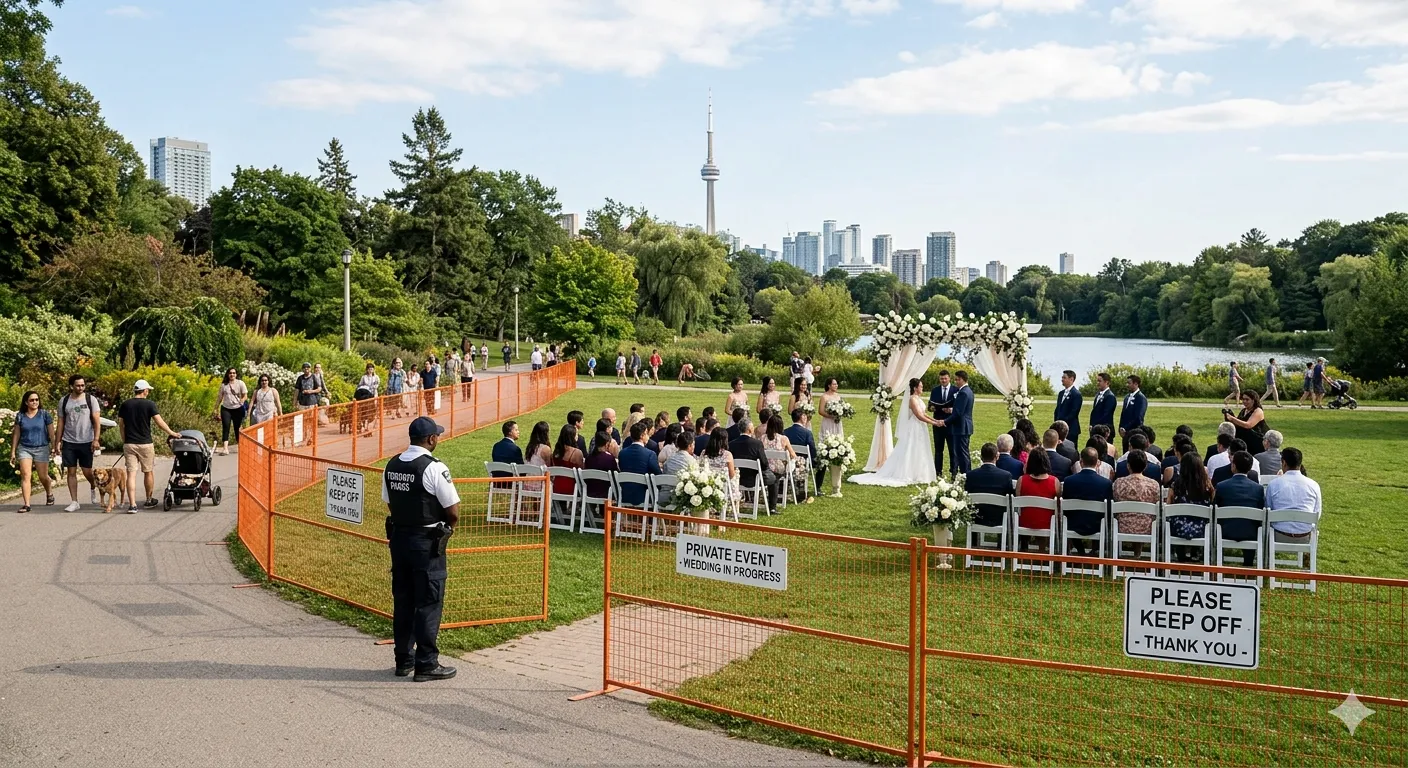
Most couples planning an outdoor wedding spend months deliberating over flowers, lighting, catering, and decor. Fencing typically comes up two weeks before the event, if at all, and usually only because someone pointed out that the venue has no perimeter and 150 people are going to spill into the adjacent park.
Here’s a more useful framing: outdoor wedding barriers are not a security measure you reluctantly add. They’re part of your venue design. A well-chosen, properly placed barrier system creates the private, intentional space that makes an outdoor wedding feel like a curated event rather than a gathering in an open field.
This guide covers everything wedding planners, venue managers, and couples need to know about event barriers for outdoor weddings: aesthetic options, configurations, timing, costs, and how to make barriers work for your venue rather than against it.
Why Outdoor Weddings Need Barriers
Let’s be practical for a moment. Outdoor weddings face a specific set of challenges that indoor venues don’t have:
No natural boundaries. An indoor venue has walls. An outdoor venue has… the idea of walls. Without physical perimeters, guests drift, non-guests wander in, and the event loses its contained, intentional quality.
Multiple distinct areas. Outdoor weddings typically need a separate ceremony space, a cocktail reception area, a dinner and dancing zone, and often a photographer’s area with good light. Barriers make these zones feel distinct without requiring attendees to read a floor plan.
Privacy. An outdoor wedding without perimeter management is visible and accessible to passersby. Most couples want their ceremony to feel private, not like a public performance.
Vendor and catering logistics. Catering setup, bar service, and vendor areas need to be accessible to staff while remaining separated from guest areas during the event. Barriers make this separation clean and professional.
Beyond practicality, there’s an aesthetic case. A well-framed outdoor space looks intentional. Barriers that match your venue’s aesthetic become part of the decor, not an afterthought.
Wedding Barrier Aesthetic Options
The biggest misconception about wedding barriers is that they all look industrial. Standard galvanized steel barriers absolutely do look industrial, and they are absolutely not appropriate for most wedding aesthetics.
Here’s what’s actually available:
Black Powder-Coated Barriers
Black barriers recede visually. Under most lighting conditions, they become background elements rather than focal points. For evening receptions, black barriers essentially disappear, which is exactly what you want. They work with almost every wedding color palette because they don’t compete with your actual decor.
This is the most common choice for weddings with a clean, modern, or neutral aesthetic.
White Powder-Coated Barriers
White barriers can look intentional and elegant, particularly for garden party-style weddings, rustic outdoor venues, or events with a light, airy color palette. They’re more visible than black, but that visibility reads as a design choice rather than an industrial intrusion when the finish is clean and the color is consistent with your overall palette.
One caution: white barriers in direct sunlight become very visible. Make sure that visibility is intentional, not accidental.
Custom Colors
For events where brand, color, or theme coordination matters, custom powder-coated colors are available. We’ve done blush pink barriers for a garden wedding and deep forest green for a woodsy venue. These require more lead time (usually 2-3 weeks) and carry a premium, but for a luxury wedding, the consistency of matched barriers is hard to argue with.
Decorative and Specialty Options
Standard event barriers can be dressed with fabric wraps, flower arrangements, greenery installations, and lighting to transform them from functional infrastructure to decorative elements. This is where creative wedding planners can really work with barriers rather than around them.
Draped fabric in your wedding colors, strung fairy lights, or climbing florals on a barrier row creates a visual boundary that doubles as decor. It’s an approach that costs more in styling but results in barriers that are genuinely beautiful.
Wedding Barrier Configurations: Ceremony, Cocktail Hour, and Reception
Different phases of your wedding day have different barrier needs. Here’s how to think about each.
Ceremony Perimeter
The ceremony space is your most intimate setting. A barrier perimeter defines the space and creates a clear visual signal to guests: “This is the ceremony area. Please take your seats.”
For a ceremony with 100-200 guests, 150-250 linear feet of perimeter is typical. You want at least two access points: one for the processional/recessional and one for general guest entry. A simple arch gate at the main entry adds visual elegance without high cost.
Keep the ceremony perimeter lower profile or more decorative than your other barriers. This is a moment of intimacy, and heavy-duty crowd control barriers undermine the atmosphere. Powder-coated white or black panels with fabric or floral dressing are well-suited here.
Cocktail Hour Separation
If your cocktail hour happens in a different area from your ceremony, while the reception space is being turned over, barriers can help contain the cocktail zone and keep guests from wandering back into the ceremony space or forward into a reception area that isn’t ready.
This is often an underplanned area. A simple 80-120 linear foot barrier defining the cocktail zone works well and can be repositioned for the reception once it’s no longer needed.
Reception Perimeter
For outdoor dinner and dancing receptions, a full perimeter helps with sound management (the reception space feels more contained), keeps evening ambiance in the event zone rather than diffusing into open space, and creates a clear boundary for catering staff and bartenders to work within.
A full reception perimeter for 100-200 guests typically requires 200-350 linear feet. Include designated service access points for catering and bar staff that are separate from guest access.
Photography Areas
Designating a beautiful background area as a photography zone with a simple barrier can actually enhance your wedding photos. It channels guests toward good photo opportunities and creates a clearly defined spot for the photographer to work. Consider your most beautiful backdrop when planning the layout.
Accessibility for All Guests
Wedding guests include elderly relatives, guests with mobility aids, and potentially guests using wheelchairs or walkers. Barrier configurations must accommodate this.
Minimum gate width for wheelchair accessibility is 36 inches. If elderly or mobility-impaired guests are a significant portion of your attendance, consider wider gate openings (48 inches) at primary access points.
Avoid configurations that require guests to navigate around barrier ends or step over base weights. Clear, wide, direct pathways to seating areas should be unobstructed.
Surface matters too. Base weights on soft grass can create tripping hazards. Your rental provider should flag surface-specific anchoring options that minimize hazard for guests in heels, with mobility aids, or who are less steady on their feet.
Case Study: Ottawa Garden Wedding
We provided barriers for an outdoor garden wedding at a private estate property in the Ottawa region. The event had 180 guests across three distinct areas: a formal ceremony in a garden grove, a cocktail hour on a stone terrace, and a dinner-and-dancing reception in a large open field.
The challenge: The couple wanted barriers that looked intentional and beautiful, not industrial. The venue had a formal English garden aesthetic, and any obviously temporary fencing would clash with it. The estate also had adjacent private property that needed to remain separated from the wedding space.
Solution: We used 280 linear feet of white powder-coated barriers for the ceremony perimeter, with custom arch gate panels at the processional entry. The cocktail area used 90 linear feet of black panels that largely disappeared against the stone terrace background. The reception field used 220 linear feet of galvanized barriers dressed with white fabric wraps and fairy lights provided by the wedding decorator.
Setup: Installation the morning of the wedding, completed before the ceremony setup crew arrived. We coordinated directly with the venue catering manager to ensure service access gates were positioned where the catering staff needed them.
Result: The couple told us the barriers were the one vendor element that “just appeared and worked perfectly without any drama.” The wedding planner has referred three additional clients since. High praise in an industry where word of mouth is everything.
Wedding Barrier Setup Timeline
Timing your barrier installation correctly matters more than most couples realize.
2-4 weeks before: Confirm your barrier layout with your rental company. Share your venue floor plan and mark where each zone begins and ends. This is also when you confirm colors, gate positions, and service access requirements.
Day before the wedding: Barriers should be installed the day before, where possible. This gives your ceremony setup crew, florist, catering team, and photographer unobstructed access to their zones without working around a barrier installation in progress. It also means any layout adjustment can happen calmly, not under the pressure of the wedding day.
Morning of the wedding: Inspection walkthrough. Confirm gates are working, base weights are secure, and no sections have shifted overnight. This takes 15-20 minutes and prevents surprises.
Post-wedding removal: We typically return the morning after the wedding for removal. This is often the most convenient arrangement because couples and venue staff are focused on other things the evening of the event.
Budgeting for Wedding Barriers
Wedding barrier costs depend on the linear footage, color choice, and service level.
For a modest outdoor wedding with 100-150 guests and a straightforward ceremony/reception configuration:
- Standard galvanized or black barriers: Setup from $300, rental from $150/day
- White or colored barriers: Setup from $350, rental from $200/day
- Custom color barriers (with 2-3 weeks lead time): Setup from $450, rental from $250/day
For a larger wedding with 200+ guests, multiple zones, and premium finishing, the budget is $600-1,200+ total, depending on configuration.
Decorator dressing (fabric wraps, florals, lighting) is typically handled by your wedding decorator and is separate from the barrier rental cost. Most decorators are experienced working with standard barrier dimensions and can quote this easily.
Frequently Asked Questions: Wedding Barriers
Can wedding barriers look good, not just functional?
Yes, absolutely. Powder-coated finishes, custom colors, and decorator dressing can transform standard event barriers into genuine decor elements. We’ve seen barriers that looked intentional and beautiful in every wedding photo they appeared in.
How much notice do you need for a wedding booking?
4-6 weeks for standard configurations. For custom colors or unusual configurations, 6-8 weeks. Summer wedding season is busy: if your wedding is June-August, earlier is better.
Can you work with my wedding planner directly?
Yes, and we recommend it. Wedding planners often have layout details, site constraints, and coordination needs that are better handled directly. We’re happy to work with your planner as the point of contact for barrier logistics.
Do your barriers damage grass or gardens?
No. Our standard base weight configuration does not damage grass. If your venue has soft or delicate ground (formal gardens, etc.), discuss this with us when booking. We can adjust the base configuration to minimize ground contact impact.
What if I need to change the layout on the day?
Small adjustments can be handled by our installation crew during setup if you contact us before they arrive. Day-of changes to major sections require a staff member. We recommend locking down your layout at least 48 hours before installation.
Create the Wedding Space You Imagined
An outdoor wedding is beautiful when the space feels intentional, contained, and private. The right barriers make that happen without imposing an industrial aesthetic on your carefully planned event.
At Lennex, we’ve provided wedding barriers for intimate ceremonies and large receptions across Ontario and Quebec. We know how to make temporary fencing work with a wedding aesthetic, not against it, and we understand that your wedding day doesn’t have room for equipment drama.
Our event crowd control and specialty fencing is available across the GTA, Ottawa, Montreal, and surrounding regions.
Ready to talk through your wedding venue setup? Contact our events team with your venue details, guest count, and date, and we’ll recommend the right configuration and colors for your event.