
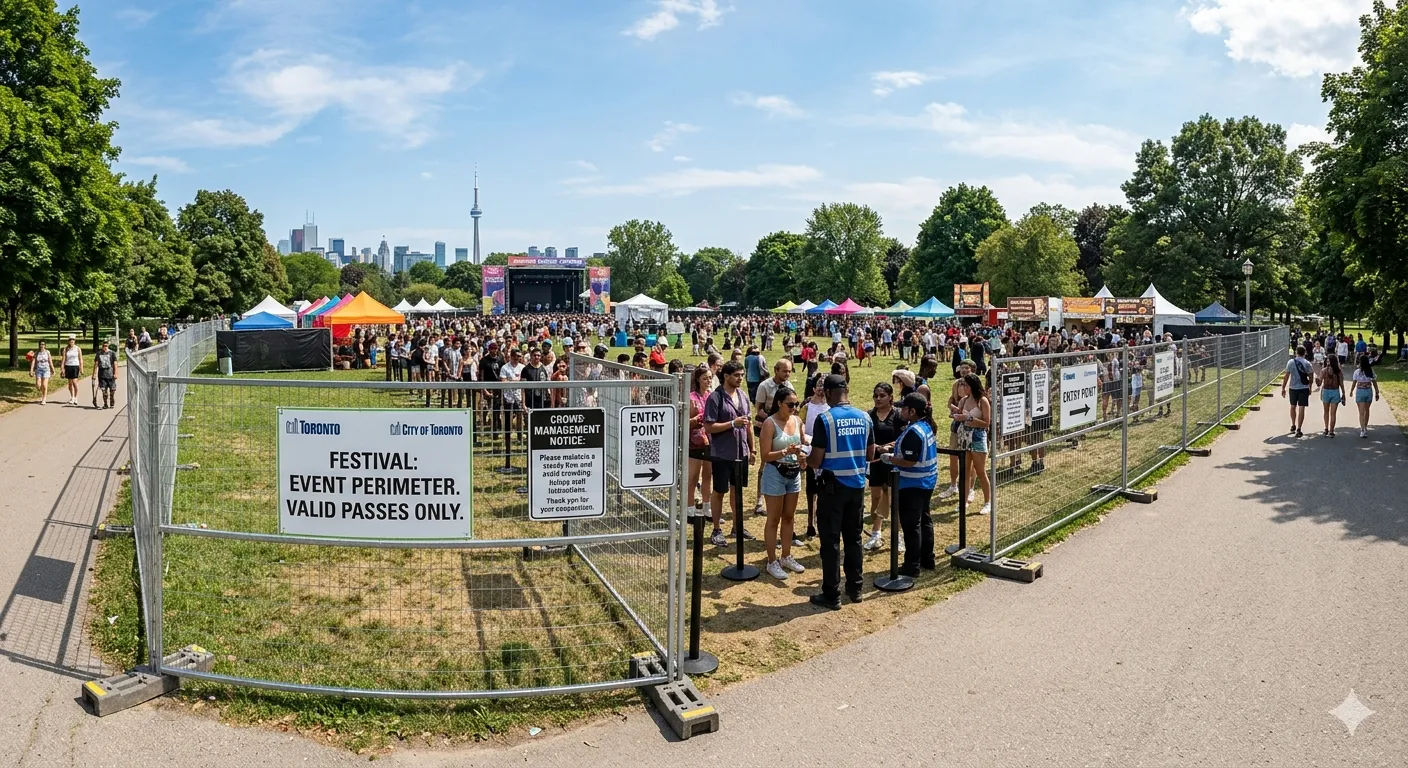
Running a multi-day outdoor festival is one of the most logistically complex things a person can organize. You’re managing thousands of people, dozens of vendors, multiple stages, restricted areas, public entrances, VIP access points, and about a hundred things that can and will change between your planning sessions and the actual event.
Festival fencing is the infrastructure that makes all of that manageable. Done right, it creates intuitive flow, protects performers and vendors, separates zones, and keeps your attendees safe. Done wrong, it creates chokepoints, confuses crowds, and leaves you scrambling to adjust on the fly when 5,000 people arrive at once.
This guide is for festival organizers in Ontario and Quebec who want to get it right the first time.
How Festival Fencing Differs from Concert Barriers
Concert barriers and festival fencing solve related but different problems.
A concert is typically one stage, one crowd, a few hours. The barrier needs are relatively contained: stage front, pit management, VIP section, and entrance control.
A festival is a city within a city. You have multiple stages with competing crowds, vendor rows with their own foot traffic, entry gates that will be simultaneously flooded during arrival windows, backstage and production areas for multiple acts, emergency corridors that must stay clear for the entire duration, and all of this running continuously for 24-72+ hours.
Festival fencing has to handle all of that, and it has to handle weather, daily wear, and the unexpected maintenance needs that come with extended operation.
Durability and adjustability are non-negotiable. The barriers you use on day one of a three-day festival need to look and function the same on day three after thousands of people have pushed against them, leaned on them, and treated them like casual furniture.
Planning Your Festival Fencing Layout
Fencing layout is where most festivals succeed or fail. Here’s the framework we use when helping organizers plan.
Start with the Perimeter
Define the outer edge of your event first. The festival perimeter determines your controlled access area, your ticketing entry points, and your emergency exit capacity.
For a 5,000-person festival on a standard park field, a perimeter of 1,000-1,500 linear feet is typical. You want enough controlled access points that your entry queue doesn’t back up into public space, but not so many that you can’t staff them all effectively.
Rule of thumb: one staffed entry gate per 500-750 expected simultaneous arrivals during your peak entry window.
Internal Zone Planning
Once your perimeter is defined, map your internal zones. Common festival zones include:
- General admission spectator area (main stage)
- Vendor/food truck row with dedicated customer access lanes
- Secondary stage spectator areas
- VIP and premium areas
- Backstage and artist hospitality (strictly controlled)
- Production and crew zones
- Medical and first aid stations (accessible but protected)
- Staff and volunteer coordination areas
Each zone needs defined barriers that create clear visual separation without creating dead ends or confusion. If an attendee can’t figure out where they’re supposed to go just by looking at the barrier layout, the layout needs adjustment.
Crowd Flow Mapping
Think of your festival as a river with tributaries. You want to design the barrier layout so that crowd movement has natural channels that prevent compression and keep people moving.
The biggest flow risk at any festival is the transition between high-density areas (main stage at peak times) and lower-density areas (vendor rows during a performance). If those zones aren’t clearly separated by barriers, you get crowd spillover that creates confusion and pressure at unexpected points.
Draw your crowd flows on paper before finalizing any barrier configuration. Map the routes for: arrival flow, stage-to-vendor movement, emergency evacuation routes (all directions), and end-of-event exit flow.
Multi-Day Event Considerations
Most festival planning focuses on day one. Multi-day festivals need to plan for days two and three as well.
Durability Under Sustained Use
Festival barriers take a beating. Thousands of people push against them, lean on them, use them as photo backdrops, and occasionally try to move them. After 48-72 hours of continuous operation, barriers that weren’t set up properly start to shift, loosen, and create gaps.
Proper anchoring and base weighting is critical for multi-day setups. For freestanding barriers, rubber feet and interlocking base weights keep panels aligned even under sustained lateral pressure. For perimeter sections that take direct crowd pressure, ground stakes add a further level of stability.
Daily Inspection Routines
Assign someone to walk the entire barrier layout at the start of each event day. Specifically check:
- Connection points between panels (these loosen first)
- Base weights and anchor points (can shift overnight)
- Gate latches and hinges (high traffic wears these quickly)
- Any sections adjacent to high-pressure crowd zones
- Emergency exit corridors (must be completely clear)
This inspection should take 30-45 minutes for a standard festival setup. It’s the kind of thing that’s easy to skip when you’re managing 100 other things, but the one time something fails mid-event, you’ll wish you hadn’t.
Weather Management
Ontario and Quebec festival seasons cover some of the most variable weather on the continent. Early summer means unpredictable rain and wind. August events can see severe afternoon thunderstorms with little warning.
Wind loads on full fence panels are significant. Standard event barriers handle moderate wind without issue, but sustained gusts above 50 km/h can shift improperly weighted sections. For exposed perimeter sections and open-field stages, additional anchoring should be part of your standard setup, not an emergency response.
Rain affects footing. Wet grass becomes unstable ground for rubber-footed barriers. If your venue has soft ground, plan for ground stakes in perimeter sections and any high-traffic areas where panels are likely to be pushed.
Managing Entrances and Exits for Thousands of People
Entrance management is where festival disasters typically begin. A well-designed entry system moves thousands of people into your event quickly, efficiently, and without the kind of crush that creates safety risks.
Entry Gate Configuration
Standard festival entry gates use a “funnel” configuration: a wide approach that narrows into individual ticket/scan lanes. The funnel prevents queue compression while giving your gate staff a manageable flow to process.
For peak arrival windows (typically 60-90 minutes before a headliner), you need enough lanes that your total queue throughput matches or exceeds your arrival rate. If 500 people arrive per minute during peak and your lanes can process 300 per minute, you will have a crowd buildup problem.
Gates should open outward (toward the crowd) for safety. Inward-opening gates create a compression hazard when crowds press forward. This sounds obvious but is surprisingly often overlooked.
Exit Management
End-of-night exits are their own challenge. After a headliner finishes, thousands of people simultaneously try to leave through the same access points they entered. Consider having dedicated exit-only gates that are separate from your entry gates, especially for larger events.
Exit barriers should channel people away from the venue in multiple directions rather than funneling them toward a single exit point. Distributed exits reduce the compression and frustration that end-of-night crowding creates.
Vendor Area Fencing: Keeping it Organized and Safe
Food vendors, merchandise, and sponsor activations have specific fencing needs that are different from spectator areas.
Vendor areas need barriers that define customer queue lines, contain vendor operations within health and fire code requirements, prevent crowd spillover from spectator zones into vendor lanes, and create clear visual anchoring so attendees can find vendors from a distance.
Food truck events have additional requirements. Health departments in Ontario and Quebec require defined service areas with clear separation between food prep and public access zones. Your barrier configuration may need to accommodate this even if your event isn’t traditionally festival-scale.
For detailed planning of food and beverage vendor areas specifically, see our food festival barriers and vendor event setup guide.
Case Study: Multi-Day Festival Barrier Planning
We worked on barrier supply and setup for a three-day outdoor music festival in the Niagara region with 6,000 daily attendees across multiple stages.
The challenge: The venue was an irregular field with a natural depression in the center that created crowd flow challenges. The organizer needed vendor areas, two stages, VIP on both sides of the main stage, and backstage for multiple artists, all connected by a shared perimeter.
The solution: 1,400 linear feet of barriers in total. The main stage pit used heavy-duty panels with additional base weighting given the slope of the terrain. Vendor rows used standard crowd barriers configured as double-sided queue lanes. VIP sections used black powder-coated barriers to distinguish them visually from the general admission galvanized sections.
Key adjustment: During our day-two morning inspection, we identified that one section of the main entry funnel had shifted slightly overnight, creating an uneven flow lane. We adjusted and re-anchored it before the gates opened. Without the inspection routine, that misalignment would have created a bottleneck during the afternoon arrival rush.
Result: All three days ran without crowd management incidents. The organizer noted that the barrier configuration on the vendor row “made the difference between organized chaos and actual chaos.” They’ve booked for the following year.
Budget Planning for Festival Barriers
Festival barrier costs scale with linear footage, complexity, duration, and service level.
For a 1,000-person single-day festival with basic perimeter and stage setup, budget $800-1,500 total, including installation and removal.
For a 5,000-person multi-day festival with full zone management, vendor areas, and VIP sections, budget $3,000-6,000+ depending on configuration and duration.
The factors that drive costs up:
- More linear footage (obvious)
- Complex configurations require more installation time
- Multi-day rentals vs. single-day
- Custom colors (powder-coated vs. standard galvanized)
- Professional setup vs. self-setup
- Weekend and peak summer premiums
One cost-saving approach for multi-day festivals: rent the same barrier inventory for all three days rather than renting daily. Most rental companies, including us, offer better rates for extended rentals.
For a detailed cost breakdown, see our event fencing cost guide for concerts and festivals.
Festival Barrier Safety and Regulatory Compliance in Ontario
Large festival organizers in Ontario need to be familiar with the relevant regulatory framework.
The Ontario Fire Protection and Prevention Act governs emergency egress requirements for public events. Your barrier layout must not obstruct emergency exits or reduce egress capacity below the minimum required for your attendance count.
For events above 5,000 attendees in Ontario, many municipalities now require a formal crowd management plan as part of the special event permit application. Your barrier layout map is typically a required element of that plan.
Frequently Asked Questions: Festival Fencing
How far in advance should I book festival fencing?
For summer festival season (June-August), book 8-12 weeks in advance. Popular equipment configurations book out in peak season. For fall festivals (September-October), 4-6 weeks is typically sufficient.
Can festival barriers be adjusted during the event?
Yes, with proper coordination. Any barrier adjustment during an active event should be done by experienced staff who understand crowd dynamics. Uncoordinated barrier movement during a crowded event creates risks. Plan your final configuration before opening the gates.
What happens if our festival grows unexpectedly?
Call us. We can often arrange additional barrier delivery with 24-48 hours’ notice, depending on inventory availability. For festivals in planning mode, we recommend building a 10-15% buffer into your initial estimate to cover this.
Do you offer multi-day pricing?
Yes. Multi-day festival rentals have better daily rates than single-day events. Contact our events team with your event dates, and we’ll work out the pricing.
Do you handle installation for large festivals?
Yes. For festivals above 500 linear feet, we strongly recommend professional installation. Our crews have done this many times and know how to work efficiently in festival environments alongside other vendor setups.
Start Planning Your Festival Fencing Today
Festival fencing is not a day-before decision. The best festival organizers in Ontario and Quebec plan their barrier layout weeks before their event, and they work with rental suppliers who understand the unique demands of multi-day events.
At Lennex, we rent and install professional event crowd control barriers across Toronto, Montreal, Ottawa, and surrounding regions. We’ve helped festivals from 500-person community events to 10,000-person multi-day productions get their barrier setup right.
Want to talk through your specific festival layout? Reach out to our events team with your venue details, and we’ll put together a plan and quote.