
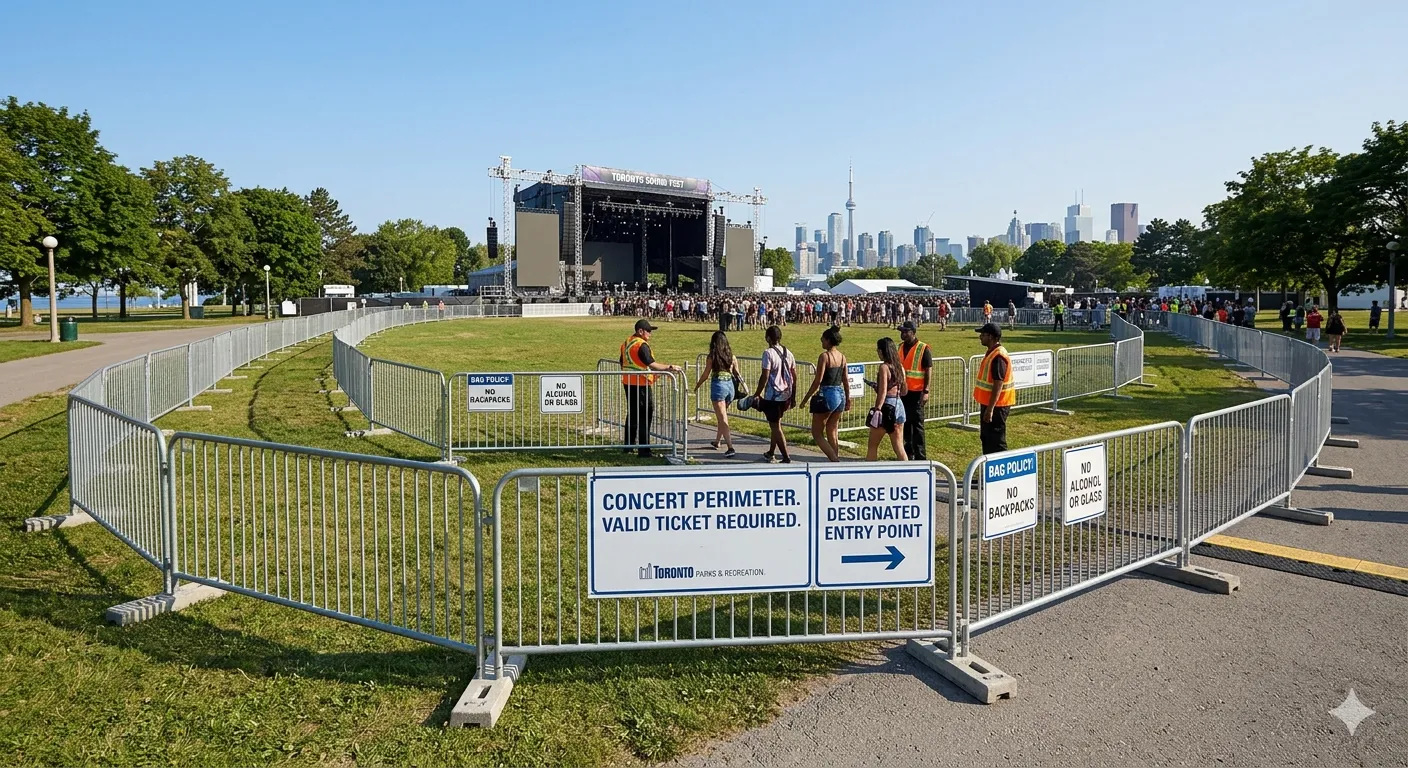
Here’s something most first-time concert organizers learn the hard way: crowd control at a music event is nothing like crowd control at a trade show. The energy is different, the pressure points are different, and the stakes are much higher when people are jammed up near a stage.
Concert barricades are purpose-built for this. They protect performers. They separate pit photographers from the general crowd. They define VIP zones without making things look like a construction site. And when they’re set up properly, most attendees barely notice them, which is exactly how it should be.
This guide covers everything venue managers, promoters, and festival organizers need to know about concert barricades: the types available, how to size your setup, safety standards you should know, what good looks like, and what to watch out for.
Why Concert Barricades Matter More Than You Think
Let’s be direct: concerts without proper barriers create liability. In Ontario and Quebec, event organizers have a legal duty of care to attendees. That includes managing crowd density and preventing foreseeable harm.
The tragedy at the 2021 Astroworld Festival in Houston is the most visible recent example. With 100,000 attendees and inadequate crowd management infrastructure, 10 people died in a crowd surge. Investigators later pointed to insufficient barriers and poor crowd flow design as contributing factors.
That’s an extreme case, but the lesson applies to events of every size. Even a 500-person outdoor concert needs defined barriers between the pit, the stage, and general admission. Not because something will definitely go wrong, but because good barriers make it much less likely that anything will.
Beyond safety, concert barricades serve a second purpose: they create the experience. A well-designed stage barrier system separates photographers, creates a pit atmosphere, and gives front-row fans that feeling of being “inside” the event. It makes a good concert feel like a great concert.
Concert Venue Considerations: What You’re Actually Managing
Before you can figure out what barriers you need, you need to understand the pressure points at any music event.
Stage Area and Pit Management
The area directly in front of the stage is the highest-pressure zone at any concert. This is where crowd density peaks, especially during popular acts. Standard practice is a stage barrier positioned 6-10 feet from the stage, creating a photographer’s pit that doubles as a buffer zone.
The pit barrier is typically the heaviest, most load-bearing barrier in your setup. It needs to handle sustained crowd pressure without shifting, tipping, or creating gaps. This is not the place to cut corners or use lighter equipment.
General Admission Flow
General admission crowds are unpredictable. They cluster at the front, thin out at the back, and surge toward the stage during peak moments. Barriers throughout the GA zone (not just at the stage) help channel this movement and prevent dangerous compression at choke points.
A smart GA layout uses angled barriers to funnel crowds away from the stage barrier, creating breathing room and reducing the “wave” effect that can knock people down.
VIP Sections
VIP zones need barriers that define the space clearly without looking industrial. Many event organizers use lower-profile, powder-coated barriers in a complementary color, or even decorative fencing for premium sections. The message to regular attendees should be clear but not aggressive: “That area is different from this area.”
Backstage and Production Areas
Performers, crew, and equipment need protection from the crowd. Backstage barriers typically run along the sides of the stage and extend into the wings. These don’t need to be aesthetically perfect but do need to be solid, well-anchored, and staffed.
Concert Barricade Specifications by Event Size
Not every concert needs the same setup. Here’s how to think about it by scale:
Small Concerts: Under 500 Attendees
A local outdoor performance, a smaller club event, a community stage, or a private corporate concert with a live band. For events this size, you’re typically looking at 100-250 linear feet of barriers.
Focus areas: stage front barrier, entrance/exit control, and one VIP or sponsor section if applicable. Setup time with a professional crew: under 1 hour.
Mid-Size Concerts: 500-3,000 Attendees
This is where things get interesting. You’re managing real crowd dynamics, multiple zones, and potentially multiple acts. Budget for 300-700 linear feet of barriers.
Priority additions at this scale: pit management barriers, staff-controlled gates, side-stage security barriers, and clearly defined emergency exit corridors. Setup time: 2-3 hours.
Large Concerts: 3,000-15,000 Attendees
Major outdoor concerts at venues like Ontario Place, Parc Jean-Drapeau, or large park spaces require comprehensive barrier systems. We’re talking 800-2,000+ linear feet depending on venue configuration.
At this scale, you need barrier management as part of your overall event security plan, not just a line of fencing at the stage. That means crowd flow studies, coordinated gate management, and a staged setup that aligns with your crowd build timeline.
Safety Standards for Music Events in Ontario and Quebec
Understanding your legal obligations is not optional. It’s foundational.
In Ontario, public events are governed by the Fire Protection and Prevention Act and local municipal by-laws that govern crowd capacity, emergency egress, and public safety infrastructure. Event organizers are required to provide adequate means of crowd management proportional to expected attendance.
The CSA Z1600 standard (Emergency and Continuity Management) also applies to many larger public events and includes guidance on crowd management planning.
In Quebec, events are subject to provincial workplace safety standards and local bylaws that may require formal crowd management plans for events above certain attendance thresholds.
Key compliance points:
- Emergency exit corridors must remain clear and unobstructed at all times
- Barrier configurations must not create “kettling” effects that trap crowds
- Maximum crowd density recommendations vary (typically 1-2 persons per square meter for standing concerts)
- Staff-to-attendee ratios apply to barrier management positions
- Documented crowd management plans are increasingly required for permits for over 1,000 attendees
Honestly? If you’re running a concert for more than 500 people, work with a professional event safety consultant in addition to your barrier rental company. It’s worth the investment.
Concert Barrier Colours and Aesthetics
Here’s the thing that surprises most first-time concert organizers: barriers don’t have to look industrial. The default galvanized silver finish is fine for construction sites. For a concert, you have better options.
Black powder-coated barriers blend into the background visually, especially under stage lighting. They look intentional rather than improvised, which matters for professional productions and brand-conscious events.
For branded events, custom color barriers can match sponsorship colors or venue aesthetics. We’ve installed red barriers for a corporate event that matched the sponsor’s brand colors perfectly. Minor detail, major impression.
For VIP or premium sections, consider lower-profile barriers with decorative panels or different finishes. The visual distinction reinforces the premium experience without the industrial feel of standard crowd control barriers.
One practical note: darker colors absorb heat in direct sunlight. For outdoor summer concerts in Ontario, factor that in. Touch a black powder-coated panel in direct August sun, and you’ll see what we mean.
Case Study: Toronto Concert Venue Setup
We set up barriers for an outdoor music event at a Toronto park venue with 8,000 general admission attendees. Here’s what the setup looked like:
Challenge: The venue had an unusual L-shaped layout with the stage positioned near one corner. Standard straight-line barrier configurations weren’t going to work. The organizer also needed VIP areas on two different sides of the stage, and the event was going until midnight, meaning barrier conditions after a full day of crowd pressure were a real concern.
Configuration: We used 950 linear feet of barriers total. The stage pit barrier was heavy-duty steel rated for sustained crowd pressure. The angled GA barriers were configured to redirect crowd movement away from the stage corners, which were the compression risk points. Two VIP sections used black powder-coated barriers to distinguish them visually from the galvanized GA barriers.
Setup Timeline: Delivery the morning before the event, full installation complete by early afternoon. We returned for a 30-minute inspection before gates opened and adjusted one section of the GA barriers based on the site manager’s walkthrough.
Result: The event ran without crowd management incidents. The organizer specifically noted that the angled GA configuration “made the crowd feel organized even when it was packed.” We’ve worked with the same venue for two consecutive seasons.
Setup and Breakdown Timeline for Concert Events
Timing matters more than most organizers realize. Here’s what a realistic concert barrier timeline looks like:
48-72 hours before event: Site walkthrough to confirm layout, measure final dimensions, and identify any changes from the original plan. For complex setups, this is also when anchoring points and ground conditions are assessed.
24-48 hours before the event: Delivery and installation. Most concert barrier setups should be complete well before your crew and performers arrive for load-in. Having barriers in place before sound check prevents conflicts between production and security setup.
Day of event: Inspection walkthrough before gates open. Check for any overnight shifts (wind, ground movement, vandalism). Confirm gate operations with your security team.
During the event, Staff at each barrier gate are monitoring crowd pressure points. Have a small reserve of barriers available for any needed adjustments.
Post-event: Breakdown typically begins 60-90 minutes after the crowd clears. For large setups, full removal may require 2-4 hours.
Concert Barricade Cost Considerations
We’ll be transparent: concert barrier pricing depends on a few key factors.
Linear footage is the biggest driver. A 200-linear-foot stage setup for a small concert is very different from 1,500 linear feet for a multi-zone festival stage.
Setup complexity matters too. Straight-line configurations along a stage are quick and straightforward. Angled systems, multiple gates, custom configurations, and multi-zone setups take longer and require more experienced crews.
Duration affects pricing as well. Single-day events, multi-day festivals, and multi-week installations all have different cost structures.
As a rough guide for Ontario and Quebec:
- Small concert setup (100-250 linear feet): Setup from $200, daily rental from $150
- Mid-size concert (250-700 linear feet): Setup from $400, daily rental from $300
- Large concert (700-2,000+ linear feet): Custom quote based on configuration
For an accurate quote on your event, the best approach is always to describe your venue size, expected attendance, and configuration needs. Contact our events team, and we’ll work through the details with you.
Common Concert Barrier Mistakes
We’ve seen a few things go wrong over the years. Here’s what to avoid:
Underestimating the stage pit pressure. The area directly in front of the stage takes far more crowd pressure than anywhere else at a concert. Using standard barriers not rated for sustained load here is a real risk.
Creating dead-end corridors. Any barrier configuration that can trap people in a dead-end during an emergency evacuation is a serious problem. Always have crowd flow mapped before installation, and always have your emergency exits clearly identified before barriers go in.
Booking too late for peak season. Summer concert season in Ontario and Quebec books up fast. If your event is June through August, get your barrier rental locked in by March at the latest. Same-day availability exists in the GTA, but it shouldn’t be your plan for a major event.
DIY barrier installation for large setups. Smaller events (under 200 feet, simple configuration) can be done by venue staff with proper training. Larger setups need professional installation. A shifted section of the stage pit barrier during a crowded performance is not a problem you want to solve in real time.
Ignoring weather forecasts. Wind loads on full panels can be significant. For outdoor events with wind exposure, anchoring and bracing requirements change. Talk to your rental provider about weather contingencies before the week of the event, not during.
Frequently Asked Questions: Concert Barricades
How many barriers do I need for a concert?
A basic rule: budget 1 linear foot of stage barrier per 10-15 general admission attendees. For a 2,000-person concert, that’s roughly 130-200 linear feet of stage barrier, plus additional barriers for VIP sections, side-stage, and entrance management.
What’s the difference between a stage barrier and a crowd control barrier?
Stage barriers (also called “Mojo” or bike-rack barriers) are typically heavier, wider, and designed to handle sustained crowd pressure from the front. General crowd control barriers are lighter and better suited for perimeter management, flow control, and zoning.
Can barriers be moved during the event?
Yes, but only by trained staff who understand the crowd dynamics of your specific setup. Uncoordinated barrier movement during a packed concert is a safety risk. Plan your configuration before the event and minimize in-event adjustments.
Do I need permits for concert barricades in Ontario?
Barriers themselves don’t require permits, but large public events typically require event permits from your municipality. The barrier layout may need to be included in your event safety plan. Check with your local municipality and venue.
How far in advance should I book concert barricades in Toronto or Montreal?
4-6 weeks for most events. Peak summer season (June-August): 8-12 weeks. Last-minute availability exists in the GTA, but popular equipment configurations book out quickly.
Ready to Plan Your Concert Setup?
Whether you’re running a sold-out arena show or an outdoor park concert, the right barrier setup makes everything safer, smoother, and more professional. At Lennex, we’ve handled concert setups across Toronto, Ottawa, and Montreal, and we know what works in each market.
Our event fencing and crowd control barrier rentals include professional delivery, installation options, and the kind of experienced advice that comes from actually having done this across hundreds of events.
If you’re planning a music event in Ontario or Quebec, we’d like to help you get the setup right. Contact our events team for a free quote and consultation.